Thursday, 21 September 2017

Playlist - Home (T)

Hi B,
I've been listening to some Indie bands from home for work and so here are some GREAT songs that I liked


Mukti Bhawan - Tajdar Junaid (its from a movie directed by an SVA Alum!)
Raat Razi - Prateek Kuhad
Tune Kaha - Prateek Kuhad
Shaad - Parvaaz
Firefly - When chai met toast

ok protip: watch all the Sofar Bombay videos on the Sofar Sounds youtube channel its great alone in ur room late evening music. makes hours STRETCH 

Sunday, 20 August 2017

Why I Like the Iliad

Glorious, epic, vast and complex are some of the words commonly used to describe Homer’s iliad but honestly, despite all the gods flying around in chariots, the near invincible heroes and the giant, battles on sprawling battle fields, the iliad is not a big story. Infact if you put it into perspective historically and geographically iys a very VERY small story but that isn’t what I mean. I mean that what makes it truly amazing is not that it tells of one immense mythological  tale, but rather, is a collage of very small very human stories.
While its incredibly frustrating to keep track of the 600+ names in the iliad, I love that homer names each and every character, giving them a name and identity even if just to identify them as they’re killed. He seems determined not to drown all those very human soldiers of his in one large death toll statistic. If someone dies in the Iliad, homer doesn’t let them die a nameless soldier, lost to the sweeping devastation of war. He makes sure you know the soldiers name or sometimes even where he’s from and what his ancestry is. It’s a valiant attempt at humanizing those that participate in larger-than-life events like the Trojan war that are romanticised and blown so out of proportion that its easy to forget that huge conflicts and great battles usually boil down to small actions by individuals and little interactions and fights between individual soldiers. In the Iliad, war is one man killing/maiming/hurting another. He doesn’t describe large trends or movements. Just individuals and their actions. Homer destroys the idea of a war being between large entities. When you say “India fought Britain” you’re talking about entities/concepts. Not people. Homer admirably avoids this and I love that.
There’s also the matter of little incidents and anecdotes within the battles and the framework of the larger story itself. Like the one where Diomedes, charging through battle leaving a trail of dead Trojans everywhere he goes, meets a Trojan (Glaukas) who’s grandfather happened to be a friend of Diomedes’ own. He insists they part friends, exchange gifts and avoid killing each other. For most of the book, Achilles is sitting out the battle and Hector appears to be commanding forces away from where homer wants our attention. So although it is the story of a few chosen famous “Heroes”, we see more of characters like Teucer of the arrows, poor Sarpedon, pushed about by the Gods’ whims and fancies. Or Glaukas, so ashamed at being wounded that he jumps off a wall or Pandarus who breaks the temporary truce between the Trojans and Greeks.

 As you plod through the Iliad,  Trojan war looks less like an intimidating old epic and more like a collage of very human stories and that B, is why I think its awesome.


Sorry this is basically the same sentence over again for 500 words. 

Thursday, 17 August 2017

Thinking About: 100 Years of Solitude by Gabriel Garcia Marquez


It's been a few weeks since I finished Marquez’s Nobel Prize winning work, and often find myself drawing parallels with some of the author’s musings and my own life, wherein his words are able to better articulate my own thoughts – that’s how you know it’s good.

100 Years of Solitude is such a vast tapestry of the human experience, that every reader of the novel can reasonably draw their own meaning from it. To me, it reveals a great paradox of Marquez’s conception: the communicative power of mutual silence, the empathetic connection of shared solitude.

Throughout the story, following the lives of multiple characters and their interactions, this theme runs constant – there is a self hidden from all other individuals, one whose trials cannot be communicated and which no one can understand, because every outsider interprets them according to their own nature and experience. This is a distance shared by all, and its acknowledgement, instead of causing people to withdraw further into themselves, provides one of the most intimate connections humans can share, a mutual understanding of, and respect for, each other’s indiscernible private experiences.

It is a realization that, if accepted, brings people closer rather than distancing them, as it is perhaps the most reliable insight one can have into another’s thoughts.

The book explores countless other themes, of which one of my favorites is the layered and circumstantial representation of emotion, how experience enables one to grow out of some sentiments, and into others, as in comparison to certain feelings, others, previously all-consuming, appear almost trivial. A line that encapsulates this perfectly follows the final thoughts of colonel Aureliano Buendia, before he is shot by a firing squad, “it was in that moment that he realized how much he actually loved all the people he had hated”.

100 Years of Solitude has the ability to bridge that gap between the mundane and the grandiose, to reveal the enormity of the most minute occurrences, to illustrate the grand fabric of human existence embedded in circadian experiences.


-  Slop

Saturday, 22 October 2016

Why Jess II

Image result for jess mariano reading

These posts are starting to just become an excuse for me to use nice pictures of Jess up. Anyway, this one is less about how Jess and Rory would fit into what the show sets out to say, and more about their relationship (albeit flawed) itself. 

1) Jess was the only one out of the three that treated Rory like an equal and not as property. I don't think I even need to mention how possessive Dean was, his constant aggression towards Tristan and Jess were testament to that, but Logan too, when Jess showed up in S6, his body language was immediately incredibly possessive of Rory and his uncalled for aggression towards  Jess reveals his need to drive him away from Rory as soon as possible, lest she run away with him the first chance she got. This lack of faith and quite frankly, misogynistic level of possessiveness is something that Jess never displays. When he finds out that Rory was on friendly terms with Dean again, he just asks her politely to tell him so that he doesn't have to find out from local gossips. 
2) Jess is the only love interest who was truly respectful of Rory. In the same incident mentioned above, Rory however, full of apologies and "nevers" and "promises", lingering habits from her relationship with Dean where she seemed to constantly have to prove herself as trustworthy and apologise to him for her friendships and actions. Even when Rory wrongfully accuses Jess of getting into a fight with Dean, he's incredibly accepting of her apology, no anger or passive aggression. Even with Logan she seems to always be treading on ice, when they first start dating she's incredibly upset at his inability to commit and later on, when he does commit,  he never seems to be mindful of what she wants, never modifies his plans or actions to make her more comfortable and he does all of this under the pretence of getting her to "take risks" and "get out of her comfort zone". In S6 episode 8 where she confronts him about having been rude to Jess, he doesn't bother to apologise he just mocks her, him and proceeds to take offence to a statement that may or may not have been about him and shout at her in front of an entire restaurant. The incident reeks of the time that Dean did something similar at the Dance Marathon. Public humiliation is uncalled for and a sign of aggression, a need to assert power. 

3) It is Jess who has Rory's best interests as a person and not just as his girlfriend at heart. Dean is constantly threatened by Rory's ambition. In Season 2, Rory prioritises planning for Harvard over a date with Dean and he gets incredibly aggressive and insecure. Then again in Season 3, closer to Rory's graduation, after her lunch with Harvard Alumni, Dean begins to get passive aggressive about the attention she was giving him and began giving her ultimatums about their future. He'd always been insecure about the status of their relationship when she went off to Harvard, and while that's a valid concern, he expected her to prioritise that over her ambition which shows how shortsighted he truly was. When Rory dropped out of Yale, Logan was apprehensive about the situation but accepted it pretty quickly, even throwing a party to celebrate her arrest for the yacht incident. While I understand that taking a year off college can be extremely valuable, Logan wasn't able to grasp that firstly, it wasn't something Rory would normally do. Since he was unable to catch on to that, he was unable to deal with the fact that she was afraid ( due to comments made by his family). Furthermore, the year off college aside, he seemed to see nothing wrong with her chosen lifestyle of D.A.R. meetings and cocktail parties that so closely mimicked that of her grandmother. This is disturbing because we know he comes from a family who would rather that Rory not work if she were to marry Logan. I find it shocking A 21st century boy from a good school and with seemingly progressive views saw nothing wrong with the fact that his girlfriend's life was starting to mimic that of her grandmother, who grew up in an era where women were offered far less choices and opportunities than they were in Rory's era. Its easy to draw parallels between this and Dean's constantly expressing that he wanted a Donna Reed-esque wife. Ugh. Either way, there were only two people who knew Rory well enough to catch onto the fact that there was something wrong with the way she was living her life: Lorelai and Jess. Its telling that Jess was the only other person who knew Rory as well as her mother, a clear indication of his genuine concern for her. Going back to Yale wasn't going to help his relationship with her, infact it could push them further apart. However, it was the best thing for Rory and so Jess never failed to express this. 


As a conclusion, here's an interesting article on why Jess shouldn't be team Rory (something I bet a lot of people haven't considered): http://www.mtv.com/news/2927430/team-jess-team-rory-gilmore-girls/

Why Jess

Image result for jess mariano reading


Gilmore Girls is a show that I only recently got into, and by got into I mean became unhealthily adsorbed and obsessed with. Its been a while since I watched an American TV show, and one belonging to the eternally ambiguous "drama/comedy" genre at that, that handled interpersonal relationships in such an endearing and thoroughly realistic way. Its also a show that deals with society and money with themes like feminism and family running deep.
Right in the first episode, there's a clear binary created between the "haves" and the "have-nots", the world of Rory's grandparents and that of stars hollow. Two completely separate societal spheres between which Rory is the bridge. The whole show is about how she shuffles not-effortlessly between these two worlds, trying to retain the salt of the earth, grounded outlook her small-town upbringing has inculcated in her while also  trying to inculcate in herself the ideals of the high-culture world of her grandparents and the privileged, idealistic world of academia.
Most of the show has her involved in this eternal tug of war between these two worlds, and at key moments we come to realise that neither of these worlds exist at all, suddenly Lorelai and her mother no longer represent sections of society but become completely and totally human. It is in these incredibly human moments, where the stark similarity between Lorelai and her mother is exposed, that its clear that these two worlds need not exist as a binary, in fact, they need not exist at all. The distinction being made between Lorelai's world and that of her mother's is what creates the rift between them. A rift that is seen to inch to a close when either one dares to cross the border and revel in the other side, as with Emily at her "bachelorette party".
Rory's love interests too, reflect her misplaced need to conform to one of these two worlds both of which are so vital to her identity. Dean quite clearly represents Lorelai's world. The world of working class America. Dean keeps his head down, he doesn't see the bigger picture and he hasn't the inclination or wherewithall to do so either. Logan on the other hand thinks he does see the bigger picture. The privileged exposure that he's been given by virtue of his parent's societal standing gives him a worldly, cultured air about him. But he too has an air of cynicism and rebellion that stems from his rich-kid sense of naivety. Both of these belong strictly to one of the two worlds, and in choosing either of them, Rory would be choosing between these worlds, defeating the purpose of the show altogether, which is to humanize the people in these worlds and make one realise that the distinctions are entirely material and totally disregardable.
The only love interest of Rory's that doesn't ask her to choose between these worlds is Jess. Jess comes from a modest background but his perspective, insight and ability to think broadly allow him to access the world of literature, a world often attributed to the higher classes. He, much like Rory is able to shuffle between the two worlds but on his own terms. He reads Proust and Dante but on his breaks from his job at Walmart. He's the only character that seems to have figured out that these two worlds need not necessarily be disparate and distinct. He knows that while there are material and economic distinctions, nothing else really separates them except will and there's nothing wrong with wanting both. Yale doesn't sound as alien on his tongue as it does on Dean's and he can relate to Rory's upbringing and her mother's world without the condescension that Logan often displays. He's not asking Rory to choose between these two worlds because he himself is an outsider to both, and yet, is able to access both.
So honestly, come November 25th, if the decision isn't in Jess's favour, I won't say I would be totally disappointed, I quite liked Logan. However, my faith in the show's ability to address things like inequality, privilege, and society will have taken a total nosedive.


Saturday, 2 July 2016

Anime Review - Noragami


Sometimes you’re just in the mood for blending fantasy with reality, for demons and Gods clashing on familiar streets and buildings, for immortal deities dealing with problems so mundane as rent, for entertaining the irrational notion that every-day school-kids and teenagers can wake up one day, to find themselves roped into an adventure playing out in an alternate dimension. It may be that you’re bored- sick of the routine each new day brings and want a fresh outlook. Maybe you’re feeling a peculiar kind of guile. Maybe you just finished watching Blue Exorcist and need something to deal with withdrawal symptoms. It could be anything, really; Noragami is the kind of show that can get you out of a funk.
Whether it’s the absurdist humour, the dead-end struggle of ‘Delivery God’ Yato, the frustrating but, unfortunately, relatable adolescent sufferings of his ‘Divine Instrument’, or the story of how they work to finally get it together (with stubborn persistence and honourable friendships, in classic anime fashion) that gets to you, this show wins you over with the comfortable ‘no-pressure’ vibe that comes with following the antics of a hero who still has to establish a name for himself, simultaneously maintaining the anticipation of rising action and slowly unravelling mystery.
The main character, fallen God ‘Yato’, is shrouded in mystery. Though the two seasons reveal some of his dubious history, the loose ends remain trailing here. The same goes for most of the main points of conflict. What each season nicely wraps up, however, are the more personal conflicts that would conventionally be considered subsidiary. Whilst heart-break and tragedy are dealt with briefly, you largely leave the series with feelings of security, shared camaraderie, and hopeful anticipation of the challenges yet to come.

The story is not over; not by a long shot. The characters still have far to go, but they’ve found a group of people that will help each other to the end. This realization can make you appreciate the similar things you have in your own life right now (or make you want start searching for them) even if the place you want to reach seems unfathomably distant.

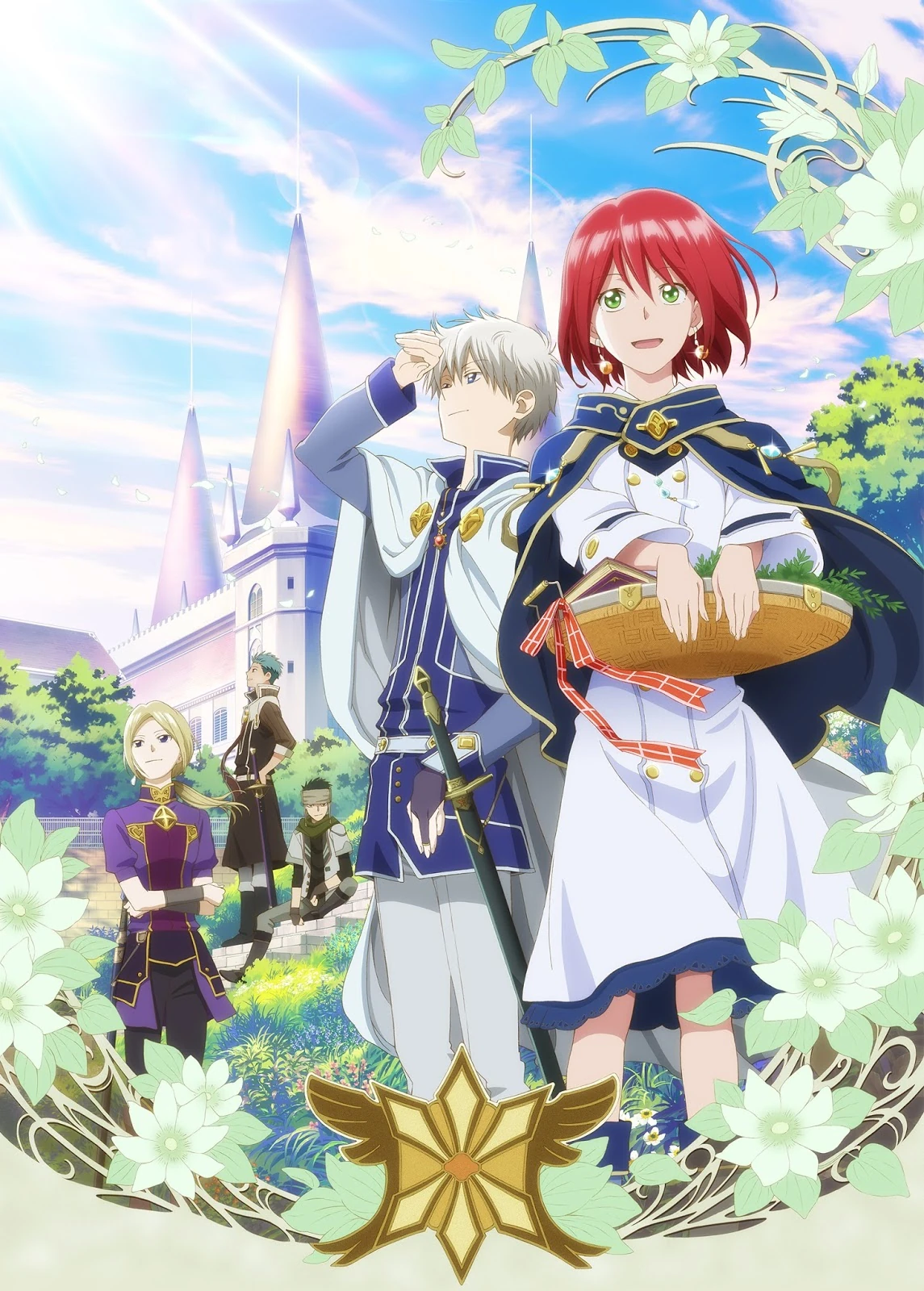
Anime Review - Akagami no Shirayuki-hime (Snow White with the Red Hair)


I didn’t go into this one expecting a whole lot. To be perfectly honest I didn’t intend on continuing beyond the first season. I was soon hooked, however. Considering this show was supposed to be nothing more than a fluffy romance to watch between meals, it delivered all I asked of it, and then some.
The first indication I got that I was in for more than I’d anticipated was sometime around the third episode, when the character introductions were developing and they got me fired up to finish my homework, spend all my free time at a volunteering centre, go outside and… generally get priorities – in the heat of summer no less. And here I thought I was going to indulge in some steamy, fan-service, fairy-tail romance intensive story arcs (more on that later…)
The basic plot line follows the life of Shirayuki (‘Snow White’), a girl who stands out for her bright red hair, which often puts her on the receiving end un-wanted pursuits and misconceptions. It could’ve ended there, with the princely character (a literal prince, in this case) taking care of the rescue operation at every turn; but anime, at-least good anime, is hardly ever that simplistic. The plot soon develops into a story of her pursuit of the path she chooses for herself, relying on nothing but hard-work and compassion, and bluntly eradicating any pre-conceived notions regarding the sincerity of her endeavour.
As is the norm, the main characters cement a special bond as the episodes progress, deriving strength, peace and purpose from each other. The development of even the more peripheral characters is heart-warming and you soon get hooked.

Without giving too much away, this show is, at the heart of it, a feel-good, slice-of-life anime with moments of laughter, anxiety, action, triumph, self-discovery, slow-paced and comforting tea-drinking, and even some cringe-worthy, cheesy romance (the icing on the cake). It may not change your life, but it’ll make you feel like you can take life’s hardships (such as they may be) in your stride. Surprising as this outcome now seems to be, Akagami no Shirayuki-hime gave me a better, more open perspective on life, at a time when I really needed it. That’s something that makes a successful work of art, right?