Wednesday, 9 September 2015

Book Review: Diary by Chuck Palahniuk


I came to Palahniuk, like many others, through his cult classic 'Fight Club'. My cynical teenage heart warmed upon reading of his nihilism and the anarchy he wove in his books. His language was crass, clipped, casual and angry. I expected much the same from my second experience with Palahniuk and boy was I wrong. 
Diary is written in a way that's almost lyrical, poetic, the devastatingly beautiful musings of a drunk and delusional mad-woman. I had to fight the urge to grab a note book and write down every second sentence 
                                The narrator, Misty Wilmot is, as I've come to realize is common place amongst Palahniuk's protagonists, thoroughly unreliable. We're led to believe she's drunk and delusional and clearly has no idea of the bigger picture she's part of. She spends most of the book at the mercy of her apparently all knowing daughter and mother-in-law. Neither she nor the reader have any idea where the story is going as a result of her being in the power of people who have very specific plans for her. The result is a narrator who is heartbreakingly helpless and terribly angry. She both narrates the present, her present to her comatose husband in the form of a diary (as the title suggests) that follows her train of thought on its most anfractuous track, as well as provides context by reliving what she calls her "other life" with her husband, Peter in art school. 
Another common theme in Palahniuk's books is surrealism and paranormal activity. There's always something bigger going on that's far stranger and other worldly than you would ever begin to guess. The book starts out simple, we're following the life of our one narrator. Around halfway through is when you realize that the littlest details that seem out of place, are out of place for a reason. The strangest clues pepper the book and you finally accept, that something really weird is going on. I'm usually really let down when I find that what I thought was a standard fiction book uses the "paranormal happenings" technique to explain whatever weird mysteries the author went about creating. It feels like the easy way out. Like the writer couldn't find anything that fit the rules of the world he/she created so they changed them up at the end to hastily put in a climax. When Palahniuk does it, somehow it works. I was skeptical when I was nearing the end of Fight Club and I was skeptical upon nearing the end of Diary, but I must say, I wasn't disappointed. I know a Modern Horror book has done its job when I'm left with a sick, eerie feeling in the pit of my stomach for days. 
One of the main themes of the book is that 'everything is a diary'. It discusses how everything we do, everything we say, make or even don't say, 'shows our hand', gives us away. Its an expression of the sheer vitality of human nature. Each and every one of us is bursting with substance. So much so that it oozes out in everything we do, our handwriting, the way we walk, talk and bleed. Palahniuk sharpens his thematic lens and focuses on artists and self portraits. He talks about how everything an artist does is a self portrait, a diary. He uses Plato's allegory of shadows on the cave wall to explain that we see the world not as it is, but as we are. There's something to think about. 
As an artist, I must also add that I thoroughly enjoyed the bits of trivia that peppered the book. Things Misty had learned in art school. Its always nice to close a book and know you have some useless knowledge to spout at the next 12 people you see. 
To conclude, Palahniuk hasn't disappointed me yet, and I pray for that the hold true for the future. Diary is an exquisite book that'll creep you out and get your mind working. I haven't read anything quite like it. 

Friday, 10 July 2015

Book Review: Gone Girl by Gillian Flynn


               Gone Girl is one of those books that had me gripped pretty much from page one. The pacing was perfect, the book never dragged and the story was immensely gripping! However, as the story progressed, I found that Flynn had failed to find a revelation/conclusion exciting enough to match the suspense she had built up over the course of the book (much like JJ Abrams disastrous conclusion to Lost!).
                The plot, after a page turner of a first half that introduced us to a tense mystery and the enigma that was Amy Dunne, totally fell flat once we we're finally introduced to her. Not only is it far fetched and excessive that a woman (even an embittered one) would go through those lengths simply to take revenge on an unfaithful husband, its self absorbed (another big issue I had with most of the characters) and unnecessary considering all she got out of it was his misery. To put it simply, I didn't feel like theirs was a story that needed to be told. There was nothing that really came out of it. None of the characters underwent any development, both of them remained just as self absorbed and pretentious as they started out and both of them went back to their farce of a marriage and sleepy Carthage (and America eventually) probably forgot all about Nick and Amy and went back to their monotonous lives! 

                   I like that Flynn obviously has enough command over her characters that she can sway our opinion of them fairly drastically depending on the perspective of the narrator. My sympathies were constantly oscillating between Amy and Nick (Although by the end of it I was quite fed up with both of them) and I was sold on pretty much every version of themselves (and eachother) that they served up! What I didn't like however is that there was not a single even vaguely likable character in the entire book. One could argue that Flynn meant for it to be that way, that she was making some sort of statement on American Society or some such thing but personally speaking, If a book doesn't have a character that I can relate to or at least sympathize with, I find it hard to be invested in the story. 
                I hated Nick for his working class cynicism and excessive pragmatism, I hated Amy for her rich-kid wide eyed optimism. Both of them clearly spent their youth believing that they had some sort of higher purpose, that the world had something special in store for them and were pissed off and disheartened when they realized that there youth had slipped away and there wasn't any sign of a purpose or destiny. The went into their marriage looking not for a partner or soul mate (or whatever its expected one looks for in a marriage) but for a story for which both of them were looking for a different angle.

               There were some things that I liked about Flynn's writing. Her attention to detail, her ability to spin the most realistically drab environments. I loved how irritatingly sleepy and typical Carthage was, I liked how thoroughly romanticized New York was and I liked the almost eerie tranquility of Desi's chateau. I was thrilled at her ability to put into clever, concise words emotions and ideas that I struggled to describe even vaguely! 

   All in all, I found Gone Girl to be a fun, quick, exciting read although utterly pointless.   


-- Chymus

Tuesday, 7 July 2015

Book Review : Trainspotting by Irvine Welsh


             It may be tempting to put the book down after glimpsing the first couple of pages, convinced that it's written in gibberish. Persevere through a couple of chapters, however, and it'll cease to feel

like you're groping in the dark for some form of comprehension. This book is written in the phonetics of an Edinburgh dialect, and not, as is the case with Anthony Burgess' 'A Clockwork Orange', in a whole new form of the English language (nadsat). So even though it is about twice as long, it isn't as overwhelming.

            The very charm of the book is, in fact, the unique narrative style. It's written in first person perspective, from the points of view of different characters. Every individual has a distinctive style of talking that brings out their characteristics - their personality type, region of birth, thought process, sex ( I was really taken by the accuracy and depth in the narration of the points of view of a few female characters- although some people may disagree) and even their level of education. By doing this, Welsh has acquainted reader with character to an astonishing degree. The first time you notice this, is upon realising that with each chapter change, it isn't immediately mentioned whose point of view the narration is from, yet you know (or atleast can quite accurately guess) which character is being written about. This, more than anything, develops the atmosphere of the story.

                  What is the storyline though? It's secondary. The plot line (or absence of one) follows the lives of a group of heroin addicts and their various acquaintances in Edinburgh, with each thread crossing another as their paths meet. The emphasis of the book seems to be on character development, and the equations between each couple, family, friend group, rival - you name it. It's as if the writer knew them personally, and shared a slice of their lives. The instances described throughout the book are challenging - be prepared to abandon all inhibitions regarding your ideas of morality, ethics, and an altogether repulsive way of life. Most of the exchanges will leave you stunned, and that is probably the point. Welsh keeps it real, laying bare the wretchedness of a world that is too often swept under the rug. Free of pretences, each page reeks with defiance, sardonic introspection, and dark humour.

                And it grows on you. The characters are not without compassion and - in some form - of loyalty. As you begin to accept the grim reality of the life they (or the world around them) have chosen for themselves, it's not difficult to appreciate their brand of wit and friendship.You begin to see really why they each tolerate people like Frank Begbie, for example. The book provides some much needed perspective on the lives of junkies. Revolting though some of them may seem, they're not so bad once you get to know them - that is assuming, of course, you're willing to look past the rampant violence, abuse and adultery. 

Sunday, 21 June 2015

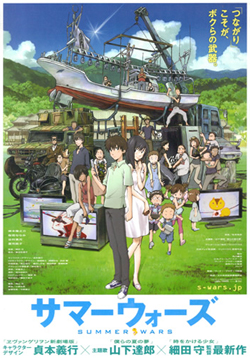
Movie Review: Summer Wars

  
Summer Wars is a Madhouse production which, in itself, says a lot more than one might imagine. The first assumption this information allows us to make is that, whatever the animated feature under discussion is, it will likely succeed in leaving the viewer spellbound. As might be discerned from our earlier reviews, we hold this particular studio in a regard bordering on absolute reverence.

The movie is a visual delight, and some of the sequences are breathtaking, but the impact made by the images has a charming subtlety to it. Upon inspection, it may be found that apparent distinguishing features in the faces of characters are hard to find. but each one is distinctly unique. Their physicalities (as well as their personalities) are brought out through their stances, mannerisms, hair, dress-sence, and other quirks, that are maintained throughout the film. This is something that distinguishes Madhouse and Ghibli’s style of general storytelling from studios like Disney and Pixar who rely on exaggerated facial features and very in-your-face physical characterization to aid them in telling the characters story.
    Characters like Naomi and Richi have, on an average, 2 lines in the entire movie but through their mannerisms and the way they act around other family members we know not only what kind of people they are but we can glean something of their relationships with most family members. Through just a few off-hand remarks and exchanges, the inter-personal equations within the family are conveyed.
         The movements have a soothing fluidity to them, and as is normal with madhouse, each gesture and movement is very suggestive of the character’s intentions. While the anatomy is not always perfect and forms are sometimes more distorted than traditionally acceptable even in stylistic animation (weirdly spindly and wobbly legs, distribution of weight in the character’s stance messed up) , they get the point across.
The house, each character, and even every inanimate object conveys a richness of its own, suggestive of untold history. Each scenery conveys so much, from taste in furniture and décor to sentimentality (keeping old photographs and letters and old artefacts from a bygone golden age) and socio-economic standing (clearly expensive ceramics, rich wood). It makes one wonder at the monumental amount of planning and scrutinizing that probably went into sustaining the kind of entrancing atmosphere created in the movie. The traditional quirks of japanese animation are also occasionally utilised, more as affectionate accentuation than anything. Madhouse has always had a knack for developing a very noticeable style while still keeping well within the boundaries of definition of “anime” as we know it.
      The visual representation of a virtual realm (along with its users, features, and partial collapse) was more than triumphant, with red outlines to produce an enticing digital effect, and made the overall experience even more ingratiating. Not only was the design of the world itself everything you’d expect from a social network on the verge of world domination (apparently quirky and fun aesthetic but subtly sleek), but the studio managed to translate many traditionally boring functions of the program into action packed sequences using visual metaphors to portray something to an audience of laymen, events and concepts that would, in actuality, take place quietly and unnoticed behind a computer screen.

   It certainly must have been a task, working with such a large and diverse cast of characters and trying hard to avoid letting any of them fade into the background. The animators however, brilliantly and subtly worked in character personalities purely through gestures and remarks. One very noteworthy scene at the dinner table brings out numerous individual characteristics by no means other than simple gestures, grabs for food, and succinct contributions to a general conversation. The familial sense of security and acceptance is brought out, where everyone is aware of each other’s’ eccentricities, and comfortable with them. However, an established hierarchy, with the grandmother at the head, reminds us of the more traditional side of this historical family. Some relations transcend domestic honorifics too, such as that of Kazuma and his grandfather, whom he addresses as ‘sensei’. We sense the dynamic that is only created through generations of shared heritage.

The storyline itself is intense, simultaneously thrilling and humbling. A broad, yet simplistic perspective laces the twists and turns. By following the global catastrophe initiated in cyber space, we glimpse the prospective reach and control of  developing technological institutions. However, the homely setting and allusions to influential ancestry seem to remind us of the relationships and connectivity that can never be made obsolete. The fact that one family succeeds in averting a deadly crisis highlights the idea of opportunities for almost anyone to influence world events through the internet, but the fact that such carnage could result in the first place reveals the delicacy of such a system, where the disturbance of one domino causes all the others to capsize. There is an emphasis on traditional means of communication that, during the unravelling of online networks, hold the world in place. It also serves to reinforce one of the primary themes in the movie, family. This is a family that is spread all over the world but they still make the time to eat and celebrate with one another whenever they can. Thousands of years of shared heritage and a stern matriarch determined to keep them as tight knit as possible has made the family bonds in this movie strong. So their victory over the forces that seek to destroy OZ is nothing but a statement on how much a group of people can achieve if they work together as a family would.
       An interesting idea introduced towards the end is the importance of a family eating together. Two of the worst things in the world are hunger and loneliness, says Granny, and both can be taken care of by eating together.
        Another interesting touch is the university baseball league, in which one of the family members is participating during the gathering, is displayed through a living room television, serving to mirror the general mood and sentiments in the household. It also provides a broader perspective by demonstrating that, while one part of the world is in turmoil, another may function completely unhindered. There are as many realities as perceptions.
           The setting of the movie itself is delightfully paradoxical. An ancient family apparently stuck in reminiscence of their golden age is faced with a problem that is purely technological in a way that is dripping with twenty first century speed and scale. Another interesting contrast is how, with OZ taken over, communications are down all over Japan which causes various security and administrative problems. Granny does her part in rallying up the troops by picking up an old fashioned phone and calling up old friends and family. In the face of a communications disaster, where the internet, the ultimate form of communication is down, here is an old woman who does the simplest thing she can think of, she picks up a phone and calls to see what she can do.

     The problem of unaddressed plotlines is unlikely to turn up, as this movie has great, but tasteful, finality. No character or dispute once introduced is ever forgotten, and everyone gets necessary screen time. They are portrayed as individuals with distinguishing strengths, that all contribute in their own way to the ultimate solution of a conflict. As a whole, the movie exudes a pride and reverence for tradition, family ties and friendship, all the while appreciating the majesty and intricacy of globalized technology.

Sunday, 14 June 2015

Anime Review: Chihayafuru (Relationships)


RELATIONSHIPS IN CHIHAYAFURU

one of the higlights of this show, was the refreshing and intricate construction of interactions between the characters, wherein even the most minute quirks of each personality are kept in mind while developing the various pairings, trios, teams, etc, and the kind of communication that would likely ensue between such characters. The relationships thus built are rich, realistic, complex, and hugely entertaining to watch.


WAKAMIYA SHINOBU AND WATAYA ARATA

In our exceedingly humble opinion, and our honest one, this is one of the most dynamic relationships in Chihayafuru. Though given limited screentime, the duo of these intrinsically lonesome, young players, that reign over the karuta world, provides heartfelt, sometimes humorous, and generally adorable moments to witness in the show. Having reached the top tier of this competitive world by employing a strategy designed to favour individual success, both Arata and Shinobu experience a lack of friendship and team experiences with people of their age group. Even within a community of shared passion, they are mostly revered, and sometimes feared, but seldom befriended. Thus, they find solace in each other’s company, and their relationship has an underlying melancholy tinge to it. Shinobu almost seems to associate competition with friendship, always searching for somebody with the same tenacity and prowess she has for karuta. In this, Arata may be her only match. It may not be apparent, but a cause of their kinship may be the fact that, for both of them, karuta is something that connects them to their grandparents, giving a sense of familial belonging rather than peer-based or team sportsmanship. What makes their exchanges particularly endearing, is their individual eccentricity and slight awkwardness, which provides a playful and enjoyable edge to the viewing of their liaison.

CHIHAYA AND TAICHI
We’re introduced to Chihaya and Taichi as long lost childhood friends just a few minutes into the show’s first episode, but it doesn’t take long for viewers to take note of the palpable romantic tension that occupies any space between them.  With Taichi’s level headedness and Chihaya’s careless tendencies, they’re incredibly compatible as friends and Taichi’s almost maternal role in Chihaya’s life is the most endearing thing to watch on screen and it’s interesting that the writers have clearly taken care to make it clear that this is a give and take, Chihaya is not Taichi’s burden. He understands that majority of her energy is focused on Karuta and that most other things are peripheral. He not only respects this but helps her make up for where she falls short. From the first time he sees her play Karuta in highschool, its clear that Taichi is developing a deep sense of respect for Chihaya as a player. This, coupled with their strong friendship is what helps them battle the strain of competition. Despite their technically being rivals, they help each other improve and wish the best for each other at every tournament.
     They clearly understand eachother very well and when they work together, they work like clockwork, so in a team tournament, they play very well together. Each one making up for and taking into account the other’s weaknesses and discrepancies.
    

TAICHI AND ARATA
Taichi and Arata have an exceedingly strange and as a result, totally hilarious dynamic. All things considered they should actually be rivals in nearly every aspect and they’re continuously thrown together in competitive settings. Both are extremely possessive of Chihaya and each resents the other for the interest Chihaya has in them. However, their having been good friends as children leaves them eternally confused as to whether they should butt heads or hug. Their delightfully awkward and confused exchanges are just cringe-worthy enough to be enjoyable. 
There’s also an interesting scene in season one at a tournament that Taichi alone, out of the Mizusawa lineup, attends. There he runs into Arata and Harada sensei of his own Shiranami society whom he is surprised to see greeting eagerly, another elderly gentleman who apparently arrived with Arata. Both boys look on at the exchange with slightly bewildered expressions on their faces. Arata explains that the elderly gentleman is his sensei and runs the society that he is registered at in Fukui. Apparently the two were rivals when they were young. We couldn’t help noticing the parallels between the two sets of rivals! It was almost like getting a glimpse of Arata and Taichi in thirty or fourty years!

HARADA SENSEI AND AYASE CHIHAYA

Harada sensei, to chihaya, is the respectable adult figure in her life, her mentor, and her teacher- as you would expect a coach to be. However, somewhere along the line (actually, probably pretty early on) he crosses over to just being her guide through her life as a karuta player. And since chihaya treats karuta as the dominant aspect of her existence, he can almost be seen as her guide through life. In him, she found the support her family failed to provide her with, initially. Even when witnessing talent like that of Arata, and skill like that of Taichi, he recognised Chihaya’s ability, and worked relentlessly over the years to hone it. Her obsession with the game is fully understood, and even shared, by him. He is one of the few people in her life as invested in the game as she is.
       In many ways, chihaya seems to mirror harada sensei’s characteristics. Both have a childishly innocent persona, which is also laced with unyielding determination, strength, and self-assurance. The enthusiasm and robust warmth with which Harada greeted Chihaya and her friends when he first met them, is emulated by Chihaya in her dealings with whomever she finds is interested in karuta. She is as accepting, open, encouraging, and even pushy as he is. They both try their utmost to further the world of karuta and those that partake in it. Atleast in this respect, Chihaya seems to be carrying on his legacy.


AYASE CHIHAYA AND WATAYA ARATA

What’s sometimes easy to overlook about this friendship, is the fact that Arata was only part of Chihaya’s life for about a fraction of a year, sometime in elementary school. Despite that, he has remained an integral part of it well into her late teens, despite their having next to no contact. The reason for this is that in those few months that they were together, he introduced her to something that changed her profoundly, and has continued to influence nearly all of her actions. This, more than anything, is testimony to the reach and impact of karuta.
      Another implication of this detail is that it makes us more closely analyse the sentiments Chihaya harbours toward Arata. They certainly were special friends, and a degree of romantic tension begins to develop as they get back in touch during their high school years, but how much of this attachment is the glorification of an idea of what their friendship could be like? Once one begins to think about it, the realisation that they don’t really know each other all that well, is difficult to ignore.
       Granted, their brief contact was one of the most crucial times of their lives, atleast for Chihaya, but, on her part, there seems to be a sentiment more closely affiliated with awe, admiration, and wonder. In that sense, the relationships between Arata and Shinobu, or between Chihaya and Taichi, seem more genuine. Still, their shared passion has most definitely woven an unbreakable bond between the two, and perhaps given some time together, they may be able to reconnect and start getting to know the people they’ve become, rather than keep holding on to a mildly outdated image, of days gone by.

THE AYASE FAMILY
I feel like this dynamic needed to be brought up because its one of the most realistic depictions of family I’ve seen in anime. The parents are neither sickly sweet nor cold and absent. They’re just regular middle class people who love their children but have jobs to do and a household to support. At first, it seems almost as though Chihaya’s family cares only for their older daughter and model, Chitose. We’re then shown an album where Chihaya’s father puts news clippings and photographs of her and her team victorious. Chihaya confronts her mother about the families apparent indifference to her incredible success in the world of Karuta and their seemingly single-minded focus on Chitose. Mrs Ayase explains that Chitose, was and is much more starved for praise and support than Chihaya. Chihaya didn’t need to be told she was doing well, she knew it. She didn’t need anything as long as she had Karuta.


OTHERS WORTH APPRECIATING

The anime is filled with a number of pairings that one may or may not see coming, but that give a sense of satisfaction, and provide depth and insight into all the characters.
       Tsutomu and Hanano ( one of the new members of the mizusawa karuta club, introduced in season 2) have a correlation in the sense that they contribute a lot to the team other than participation in matches. They analyse data and size up the opponents. Tsutomu was the one who saw value in the seemingly trivial observations made by Hanano, giving her some belief that she may have a place in the world of competitive karuta.
         Chihaya and Kanade, though widely differing in their adherence to differeny aspects of the game, share an almost equally intense passion for it. Chihaya not only accepted, but also attempted to understand Kanade’s unconventional love for karuta, even when others dismissed it as irrelevant to the competetive aspect of the game. Chihaya took the time to view the game from Kanade’s perspective, and used that insight to enrich every team member’s playing style further. The two have respect and admiration for the other’s approach to the game, and even their personalities seem to complement each other ( Chihaya’s childish naivety, with Kanade’s pragmatic maturity and perceptiveness)
        The similarrity between the thought processes of Taichi and Tstutomu is evident when Taichi understood that Tsutomu initially rejected karuta because it failed to further his academic interests. Taichi taught Tsutomu what his own experience had taught him- that karuta opens up a whole new world of adventure and challenge, more treasured than any success in class.
           Even when Yamamoto Yumin competed with Chihaya, Nishida, a teammate of Chihaya, continued to root for Yumin because she was part of the same karuta society that Nishida practised at. They had no other relation, but Nishida continued to support her over his new teammate because they were bounded by loyalty to their karuta society. This sense of honorable affiliation and reverence between fellow players is prevalent through the show, and truly gratifying to witness in these unforseen instances.

Wednesday, 20 May 2015

Anime Review: Chihayafuru (Karuta)

The Rules

Competitive karuta is a one-on-one game, facilitated by a reciter (card reader) and a judge. All official matches use cards made by Oishi Tengudo.
Each player randomly selects 25 of the 50 torifuda cards that are also randomly selected from a total of 100, and places them face-up in three layers in his or her territory. A player's territory is the space in front of the player, 87 cm wide and separated from their opponent's cards by 3 cm.[1] Players are then given 15 minutes to memorize all the cards in place, and for the final two minutes they are allowed to practice their strike at the cards.
The game starts by the reciter reading an introductory poem that is not part of the 100 poems. This introductory reading allows players to familiarize themselves with the reciter’s voice and the reading rhythm. Following the introductory poem, the reciter reads one of the 100 yomifuda. 50 out of this 100 yomifuda are on the game as torifuda, and remaining 50 cards are also read as karafuda (ghost cards).
The first player to touch the corresponding torifuda "takes" the card and removes it from play. When a player takes a card from the opponent's territory, that player may transfer one of their own cards to their opponent. If both players touch the target card at the same time, it is taken by the player whose territory it is in.
If it comes to luck-of-the-draw, the most efficient way is to defend the card on your side of the game.
The first player to get rid of all the cards in their territory wins.
Otetsuki (Faults, False touches)
  • ¥ Touching the wrong card in the same territory as the target card is not a penalty.[2] As a result, the players may toss away surrounding cards near the target card.
  • ¥ Touching the wrong card in the wrong territory results in a penalty. The opponent may then transfer a card from their territory to the faulting player's.
  • ¥ When a player touches any card when a ghost card is read, they incur a penalty.
Double faults
  • ¥ If a player touches the wrong card in the opponent's territory and the opponent touches the correct card in the faulting player's territory, it is a double fault with a penalty of two cards.
  • ¥ When a player touches any card in both territories when a ghost card is read, they incur a penalty of two cards.
The order of the cards in a players territory may be rearranged at any time during the game. However, excessive rearrangement is considered poor sportsmanship.


(source: Wikipedia: Competitive Karuta) 

–––––––––––––––––––––––––––––––––––––––

Karuta

The extent of the luminescent portrayal of this game in Chihayafuru can be understood when acknowledging the fact that it continues to enthrall a multitude of viewers, over the entirety of its two seasons, irrespective of whether or not they’ve ever been exposed to Karuta before- (indeed, most may not even understand a substantial number of the rules). How then, does it so successfully absorb all those who watch it, into the storyline? 
  Possibly, because we are given detailed insight into just how it affects the lives of the players, what they hope to gain from it, the various facets of the game that make it most alluring to each player, and how they develop their individual playing styles over the course of the show, along with their personalities.
from fairly early on its pretty evident that Karuta is a very versatile game. It has all the characteristics of a sport, requires physical and bodily command and is even played competitively. However, its grounding in classical poetry and the creativity it allows players in their playing style all hint at it being an art form. 

    The games themselves have an almost ritualistic nature with special emphasis on politeness. Opponents bow before on another and greet each other with formal requests to be looked upon favourably. After the game is over they bow once more and thank one another as well as the reader

         Rigid bonds of friendship are developed between players of karuta, as people sharing this mutual obsession fight together. It is battle between different regions, schools, and karuta societies. They play to defend the honour of whatever group it is that they represent, whether they’re competing alone, or beside their teammates. Every individual match is a team match,  and every team match is an individual match.
        Each character perceives the game in a unique way, and thus we begin to glimpse the intricate complexities that make up this world of karuta.


THE GAME AND INDIVIDUALS


CHIHAYA:
Chihaya dived headfirst into the competitive aspect of the game. For her, it’s all about passion, speed, and instantaneous reactions- impulsiveness, and faith in instinct. She was blessed with exceptional hearing, and this is what gives her the edge over most of her opponents. She can tell what poem is going to be read, by the changes in the reader’s voice, almost before it’s even begun to be read. It was reliant on this advantage that she won her first card in a friendly game against Arata, and so has invariably continued to depend on this strategy.
      This effervescent playing style often leads to her neglecting the other factors of game-building- such as memorization of the cards, card placement, understanding the opponent’s own playing style, and strategy, all of which are important in developing an invulnerable game. She identifies the cards purely by sound, and so the true meaning behind each poem, and the rich atmosphere created by  each poet, is often unknown to her. Her aim is to be the best player in the world, and so her focus lies in strengthening her chances in competition. Everything else is supplementary to that.
        Chihaya isn’t just an overwhelming enthusiast when it comes to karuta, she is utterly devoted to it. In her childhood years it brought to her something irreplacable- it gave her an identity. She ceased being just her sister’s untiring support system, but began rooting for herself. Karuta gave her individual goals, and something to dedicate her passionate heart to. It also gave her an unforgettable friend and teammates, for which she stays eternally grateful. 

KANA:
Kanade’s distinctive love for karuta is of a brand widely differing from that of Chihaya. She has an emotional connection with the poems on the cards, and the poets who wrote them. Her understanding of human nature enables her to delve into the sentiments laid down by these hundred poets of old, and form an interminable attachment with them. She had memorised analysed each poem multiple times over before she even began playing the game, and it is the traditional aspect of the game that draws her. To her, karuta is an art – evoking emotions and deeply moving the players as well as the audience, as each poem is read.
      Since it is the stories behind the poems that intrigue her, Kana is easily able to draw associations between the poems of the same theme, and even between the poets. She thus arranges the cards according to the kind of poem on them, which is quite unusual. She identifies the cards by the atmosphere created by the words in the poems, often seeing them in different colours and moods. As audiences, this is fascinating to see. Her keen knowledge gave her team members an insight into this often neglected aspect of karuta, enriching their perception and game styles as well. She is one player who is truly well acquainted with the cards, and regards them as close personal friends.
       In her search for tradition and respect of Japanese culture and art, Karuta proved to be her slavation. It gave her an opportunity to compete in traditional wear that enhances her body’s endurance, and add perspective to her beloved study of classical literature. Her aim is to become a reader herself, so she focuses on building her understanding of the poems, paying close attention to the poetic impression, tone, timing, and articulation of each prominent reader that appears in a tournament

SHINOBU:
Shinobu is the best there is. She is the reigning authority in the field of karuta, the untouchable queen. This means that her game is flawless, and her defence impenetrable. She is always ahead of her opponents because her movements are swift, direct, and above all, accurate. She sits at the top … all by herself. It is evident that she has no one to share her drive, no team to win or lose for, and is making this journey solely in the company of her cards, and her game. 
       It’s no wonder she is so possessive of karuta. She lunges toward the right cards at the earliest instant, making authoritative grabs, averse to the idea of letting even one them be stolen from her. She makes it impossible for her opponent to reach the cards she has her eye on. She has one of the strongest connections with cards of anyone, and probably regards them as her best frineds. This is why her swings are determined and unfaltering- she believes she is fighting for something that belongs to her, and which she has an obligation to protect.
        Her backstory is atypical. She and her mother were allowed to live with her strict grandmother under the condition that Shinobu learn a skill, and Karuta was what she chose. The cards fascinated her, and she has held on to the bond she shares with them. Even though she is a league above most of her competitors, she is discouraged by the loss of every single card, and is on a quest to make her game perfect. She wishes never to lose a single card. Yet, she enjoys playing against sturdy opponents that refuse to give up, and, more importantly, share her passion. This shared connection motivates her to continue playing. She is on the lookout for people that may pose a threat to her winning streak, so she may once again experience the thrill of struggle and challenge and prove that she deserves to win, against even the strongest.

MASHIMA TAICHI
 Mashima Taichi is an academic overachiever and apparently excels at sports. From this its easy to infer that his strength lies in his mind. He’s extremely logical and has tremendous mental capacity. These talents when applied to Karuta result in his ability to memorize card positions quickly and keep track of which cards of what syllables have been read throughout the game. In team competitions he’s the team’s rock. His incredible mental strength enables him to keep calm in an atmosphere of high energy and tension.  He is able to focus on his game while keeping track of his team mates and lending them some of his strength when they falter.  
        That being said, his weakness is his lack of focus on the physical aspect of Karuta. His swings are not as practiced or accurate as Shinobu’s, nor does he come close to Chihaya in terms of speed. He is, however, able to pinpoint his weaknesses and works on them over the course of the show. His improvement in Karuta also stimulates changes in his character, this is what shows you that Taichi is genuinely invested in the game (although he makes it seem like he only plays so he can beat Arata and keep an eye on Chihaya). He, like Chihaya, was inducted into the almost cult like society of competitive Karuta when he was very young, so it obviously played an important role at a very pivotal point in his growth. Unlike Chihaya however, Taichi’s love is not as pure and is grounded much more in challenge and victory. 

DESKTOMU
       Tsutomu or Desktomu, as we know him, only came to Karuta because it looked like something he couldn’t excel at. He expresses his desire to be “Number 1” and questions Chihaya about whether Karuta will help him get there. His attitude is almost disdainful, until he sees Chihaya and Taichi play.  His love for Karuta is grounded in his desire to challenge and to excel, to think and to reason.  His playing style is nothing special, he plays by the rules, but the fact that he doesn’t develop a distinctive style allows him to be more versatile. Desktomu’s talent lies in his ability to identify his opponents playing style, strengths and weaknesses almost instantly and alter his style to counter it. 
         He sees that Karuta is not only played on the field. The players are important and their behavior, build, and attitude as well as immediate state all factor in to how well they can play their next game, so he collects data for the rest of the team. He observes their opponents and takes notes so that he can make inferences and make suggestions based on this information. He also documents his own teammate’s games and advises them on what to focus on and areas they could improve. Desktomu, despite his often lackluster performances on the field, is an essential part of Mizusawa’s team. 

     
 NISHIDA
    Nishida is probably the most experienced player on the team. He’s been playing longer than Chihaya has and more consistently through the years than Mashima. His Karuta Society churns out players who play a defensive style of Karuta, and so Nishida tends to avoid attacking his opponent’s cards and focuses more on his own (evident in his match against Mashima  which ends up being a ‘Luck of the Draw’ ) His experience gives him a certain edge over the others and where they flounder against opponents with unusual playing styles, Nishida is used to adapting quickly, due to his having played numerous games against a vast variety of opponents. He also tends to always be in a state of comfort when he plays Karuta, again, a result of his years of experience. This keeps him calm and level headed and helps him concentrate on the game.  Furthermore, being in the circuit for so long, he’s familiar with a lot of the opponents and is aware of the extent of their abilities. 


    IMPORTANCE OF READERS 

Although not given too much screentime during the show readers too, play an integral part in the Karuta world. To become a reader one must first be a Class A player and take numerous exams and tests in order to be certified (as a result there are only 7 certified readers). This is why, readers,  perhaps, have the most insight into the world of Karuta. They understand the game itself well enough to secure places in the highest class, and naturally, they understand the importance of the poems themselves. 
    Kyoko Yamashiro for example, is one of the most revered readers in the Karuta world. It is said, when she reads a poem, players are consumed by sights and sounds being described almost instantly, they’re transported. For example, if she was to read the Swift Gods card, one would feel as if one was in an autumnal forest beside a river swimming with flaming red leaves. This almost makes it easier to identify what card is read and grab the second verse card (That is, if one is familiar with the poems and what they depict) 
    The timing of the reading is also a vital part of the reader’s job. In high-tension situations where players and audience members alike are thoroughly on edge, an extra second between verses or poems could cause a fault and neglecting to pause for the correct time could throw the players off. So needless to say, one must have impeccable timing (which is harder than it sounds, as demonstrated by Kana in season 1) 
For readers like Ayase Chihaya and the current Master, Hisashi Suo, who rely a great deal on their ability to pick up specific sounds, a good reader is important, a familiar reader, even better. They’re able to pick up on the slightest of lilts in the reader’s voice that lead into the next word and thus, are able to distinguish between more 2 and 3 syllable cards than most players (for Suo, 28 of the cards are 1 syllable cards. Ayase has 20) 


BUILDING SPECIFIC STRENGTHS


There are a number of different ways of tackling competitive karuta, that are explored throughout the show when each competitor is scrutinized during matches. The ultimately constructed individual playing methods are linked closely with each personality, to create an approach best suited to them. 
         One of the well-respected high school teams from an elite academically inclined school uses an eccentric tactic to throw off their opponents. They rearrange their cards multiple times throughout each match and use their superior memorization skills to commit each new pattern to memory. There’s no particular strategy in their card arrangement. They simply seek to play to their skills and leave their opponents utterly disoriented with the desultory card movements.
           The previous Queen, Yumin Yamamoto, intimidates her opponents by confidently contesting each ambiguously played card. The struggle often leaves her opponents in a mentally famished state and causes them to avoid even the slightest risks.
           The Hokuo team, with their years of experience and successive victories, have a highly developed team- playing style. They are able to strategize their individual games relative to the progression of the games of the other players, to ensure the required number of overall victories. This coordination between closely-knit team members makes them foremost in high school tournaments. 
            Master suou, the undefeated, plays a karuta similar to that of Chihaya. He uses his exemplified sense of hearing. This functions at its best when a highly regarded reader known as Kyoko Yamashiro reads the cards, as she seems to understand the depth and meaning behind each poem, and her voice seems to create an atmosphere unique to each card. Suou recognizes this, and reagards her as his favourite. It is only when Yammashiro reads that Suou is able to defeat Shinobu, whose ears aren’t as sensitive. It is thus evident that readers play a critical role in the outcome of a match, if players like Suou and Kana are competing.


There is obviously much more to karuta than meets the eye, which is why many players spend their entire lives enraptured by it, constantly learning, discovering new strengths, new talent and new reasons for why they hold on to it so tight. Many spectators might be fatigued by its apparent monotony in the duration of one match. But for those invested in it, that have been playing even for decades, karuta still never fails to surprise.

Saturday, 9 May 2015

Anime Review : Chihayafuru ( In depth character analyses)


 CHIHAYA AYASE


Episode one begins with Chihaya putting up posters for the Karuta Club she plans to start in school on the school bulletin board, dressed in her school uniform and a pair of trackpants (worn underneath her school skirt) and a utilitarian tool-belt-esque device around her waist (containing posters for the Karuta club of course) as her classmates gape at her and Ms Miyauchi balks at her to remove the ridiculous trackpants (which she wore after being told she couldn’t stand on a chair and put up posters in her short school skirt). Chihaya then proceeds to cock her head in true Chihaya fashion and begins to remove the trackpants right there and then, surrounded by her flabbergasted classmates. You’re pretty much guaranteed to fall in love with her after that introduction. 
      Chihaya is the passion of the group. Before Karuta, the only role she played was that of ta doting younger sister to Chitose, the budding model. When Arata introduced her to Karuta, he not only gave her a hobby and a passion, but an identity. She lives and breathes Karuta. Every decision she makes, everything she does is done to help her improve at this strange and obscure game (eg: joining the track team so she could stay in shape, to keep her speed and so that she could meet people whom she could recruit to a Karuta club).  Her love for Karuta, unlike that of so many of her peers, is independent of her determination to win. She loves to play Karuta and that’s all there is to it. She doesn’t view her teammates or opponents as enemies, but as fellow lovers of the game and is eager to teach and help newcomers improve. She practically exudes passion and her love for Karuta is contagious 
          Further emphasizing her borderline obsessive attitude towards Karuta is her airheaded, naïve attitude. Her attention was, and is, focused completely on the game. It consumes her mind and inhabits her every thought. As a result, she doesn’t have much energy (mental or physical) to spare on anything else. So she’s oblivious to the snide comments aimed at her by baffled classmates (eg: beauty in vain) and clueless of the intricacies of human nature (which, for her is but another aspect represented in the Hundred Poets). She insists in seeing the best in everyone and has a keen eye for potential (As in the case of Desktomu, an unlikely member of the club at first.)
      Perhaps the most interesting and admirable thing about Chihaya’s character is her ability to learn and improve her Karuta significantly everytime she plays an unfamiliar opponent. She takes something away from each and every match. She’s incredibly perceptive when it comes to Karuta (not so much otherwise) and picks up on the slightest quirks in her opponents playing style and works hard to see what she can glean from her findings to incorporate into her own style. 

      
TAICHI MASHIMA


If Chihaya is the passion, then Taichi is the mental strength- of the Mizusawa Karuta Club, and of the anime as a whole. Where she is expressive, accepting, and often boisterous, he is reserved, mature, and calculating. She launches the members of her team toward perplexing and demanding situations, so he makes sure to pack a few parachutes. In the beginning, it can be quite difficult to actually like Taichi. He’s judgemental, arrogant, and seems to be motivated by nothing but self-interest. He comes across as one of those characters just begging to be antagonised. This is where Chihayafuru first begins to surprise. Taichi is probably one of the most well-developed characters ever written, relentlessly growing, and persistent in his struggle to shed his past weaknesses, so that it eventually becomes impossible not to rank him as one of the favourites. Who he is as a person never really changes, which is why this progression can be so well appreciated. He isn’t innocent or open like his best friend, but values those qualitites in her. He never looks down on people but strives to improve himself, and this can be seen through the way he builds up his playing style. Posessing an unwavering fighting spirit that even he may not recognize, Taichi is who the team looks to for assurance and stability. He seems to be in a battle with his own vices, and impressively appears to be winning. There is a search for passion, identitiy, and bravery. It may be tempting to question the motives behind his actions (many do so) but it is soon evident that they are pure. A complexity of thoughts, laced with shades of grey, he is difficult to figure out, but in the end, someone who is there to stay.   

KANADE OE


Kana is the romantic of the group - the emotion. Her family owns a traditional clothing store, so it can be said that she’s been brought up fairly steeped in tradition. To top that off she’s obsessed with classical poetry. Not only does she know all Hundred Poems by heart, she is also aware of the common interpretations and has some of her own as well. Her ability to glean the poets’ deepest meanings from simple descriptions of nature is telling of her deep understanding of human nature. Where Taichi’s intelligence is that of logic, memory and reasoning, her’s is that of emotion and sensation. She can identify the dynamic and tension between two people far before anyone else. 
   Unlike the others in the group, her affinity for the poems on which Karuta is based causes her to view Karuta as more of an art-form than a sport, which results in unusual card placement techniques and strange methods of identifying the cards. She also derives strength from the element of tradition that still lingers in Karuta (eg: she plays better when dressed in traditional clothing. It helps her balance and posture) 
    She also plays the more traditional/old fashioned role of a woman, and takes it upon herself to take care of everyone in the club. Her mother accompanies them on trips (presumably at her request), she provides the clothing and transport to and from tournaments and the first thing she does after joining the club is insist that they clean up the Club room and make it more fit for habitation. 
        She is not to be underestimated. Though she seems innocent and naïve, she is extremely shrewd and has a fantastic business sense. When she is asked to join the club she does so under the condition that Chihaya agrees to model for her family’s catalogue (they couldn’t afford an actual model) and, recognizing potential patrons in the Karuta world, around half-way through the first season her mother announces that they’re now offering a special line of cotton traditional clothing for competitive Karuta! 

YUSEI NISHIDA 


Commonly known by his unflattering nickname ‘Porky’ that caught on as a result of his deep-rooted love for pork buns, Nishida may be an easy character to disregard. But lacklustre characters in Chahayfuru are a novelty- and they aren’t so easy to find. It is not until he falls short, that anyone is able to realize just how dependable Porky is. One of the most experienced karuta players, well established in this niche society, he is the one indisputably relied on to secure atleast one win for Mizusawa in team tournaments. The first win often sets the tone for the matches of the remaining players, and is a coveted spot Nishida effortlessly secures on numerous occasions, throughout the show.  He was salvation for Taichi and Chihaya in their efforts to start a successful karuta club in school, and his presence began to lend an air of relief and security. He brought hope and strength, a steady, definitive weapon in the Mizusawa arsenal. Though not ouwardly emotional, he possesses a strong sense of loyalty (as is seen when he supports Yumin Yamamoto- a fellow member of the local karuta society he belongs to). He takes his losses seriously, as karuta is something he plays to win, and is often greatly discouraged if he fails to rise to the occasion. In this way, karuta is as much part of him, as it is of Chihaya.  It never pays to brush aside characters that can, if only considered, possess the same unexpected amount of depth and relevance as Porky. Having said that, there is room for more insight into his character, that could perhaps have been made a bit more discernable.

KOMANO TSUTOMU 


When we’re first introduced to Tsutomu he’s Chihaya’s snide, arrogant classmate who’s perpetually trapped behind his desk with his nose in a book. He has no interest in playing Karuta or having teammates (or even friends for that matter). He just wants to be number one. He’s drawn to Karuta because it’s a challenge for him. He immediately grasps that it’s not just a game of coordination and reaction. It’s a game of memory and analysis as well - two things he prides himself on.  
    He’s also probably the only one out of the entire Mizusawa team who is truly a team player, and this is a development which, again, demonstrates the way character identities in this show are developed through the game. With the addition of the two new teammates in Season 2, there isn’t always room for him among the 5 members that play a match, since each new opponent requires them to emply a different set of strengths. Tsutomu recognizes this almost immediately. He understands from his very first highschool tournament that his role as a Karuta player is not much compared to that of Chihaya or Nishida. His strengths lie elsewhere. He collects and analyses data on opponents and even his own team’s playing styles and history, and uses it to help them come up with a strategy. He identifies chinks in their opponents’ armour and hands the arrow to someone on the team who’s more able, so that they may shoot to take each competitor down. 


ARATA WATAYA


Arata’s character is vaguely reminiscent of a minor tsunami, that modestly hurls itself upon an unsuspecting coastline, demolishes a few odd villages, and then casually recedes into the ocean, calmly oblivious to the carnage it caused. An unthreatening, recluse in spectacles, he has the uncanny ability to thoroughly jostle the life of anyone in the karuta world, making sure they never forget him. Even though he’s rarely the centre of the story, past the first few episodes,  he continues to maintain an unshakeable presence throughout most (if not all) of the episodes. The ubiquitous memory, the knowledge universally possesed, Wataya Arata is a name that is recognised by most, revered by many, and resented by none less. So how did he obtain this reputaion? He’s just that good. Karuta has been a part of him since the very beginning. The grandson of the ultimate Master (best male karuta player in Japan, i.e in the world), he was descended from a legend, and seemingly destined to become a legend himself. Greatness was expected of him, but no one could have foreseen the extent to which he mastered the game. Arata met the soaring expectations laid down for him, and hugely exceeded them. Many believe he is the only one capable of one day posing a threat to the reigning master (Master Suou), possibly overthrowing him. Infamous though he is, few are aware of the insecurity that lurks in the back of his mind- he is lonely.  Rising to the top certainly had its price, and it left him envious of those possessing a bond that only exists between members of a team, fighting for each other, gaining strength from each other, and succeeding for each other. It is this experience that he most cherishes, but one that seems to be eluding him, hovering just 
out of reach.


WAKAMIYA SHINOBU


Shinobu is probably the most intriguing and most endearing character on this show. The first thing you notice is her skill at Karuta and how very blaze she is about the fact that she’s queen (the best female karuta player in Japan). She almost seems arrogant and obnoxious when she asks opponents to go easy on her, or says she’s nervous about playing them. Truth be told though, she’s just as innocent as Chihaya. She’s obsessed with a ridiculous cartoon character called “Snowmaru” and buys expensive merchandise to feed her obsession. She has the fashion sense of a rock, and just wants to play a good, exciting game of Karuta for once.  Where Chihaya does nothing to mask her naivety, Shinobu tries to cover her’s up with an air of indifference, as a result of which she always looks bored. During games as well, all she wants is an opponent who can challenge her so she can play the kind of Karuta she likes, so she can lose herself in the intensity and energy of a match without holding anything back. Her love for Karuta, like Chihaya’s, is independent of her almost habitual victories. She doesn’t play to win. She plays to improve.  Her attachment to the cards is also something you can’t help but admire. She’s possessive of them. Karuta is something that she treasures. It’s her salvation and she wants to keep it that way. That’s why she’s Queen.


HONORABLE MENTIONS


  It’s easy to get attached to this anime, not only because of how invested one becomes in the stories concerning the main characters, but also because of how devoted one finds oneself to even some of the side characters. Competitive karuta is composed of a small group of enthusiasts, and slowly their strengths, weknesses, and quirks become as identifiable as those of the main characters. 
Harada sensei, who runs the ‘Shiranami Karuta Society’ is a robust old man who has devoted his entire life to the game. In him, the younger players find a respectable mentor- an idle to emulate and depend on. There are a number of such figures in the show.
       Sakurazawa is the superviser of the ‘Fujisaki School Karuta Club’ and may come across as dubious character at first, but turns out to be a highly regarded veteran, who recognised the talent of Chihaya and Taichi when most others overlooked them. It is thus apparent that she isn’t working for the benefit of  only her team, but that of the world of karuta as a whole.  
           Ms. Miyauchi, also known as ‘The Empress’ at Mizusawa High School, is the inexperienced faculty supervisor if their karuta club. Skeptical at first, she soon develops a deep respect for the game and strives to be of aid to her team in any way she can, never having played karuta herself. In her the students find a reliable caretaker, and she does her best to provide whatever resources the school can, to her club. 
            The Mizusawa club forms a special bond with the ‘Hokuo Karuta Club’, one of the strongest clubs in Tokyo. They comprise some of the most eccentric characters- Retro, for one, who Taichi soon sees as a comforting face at tournaments, and who aids the Mizusawa club once they stop being rivals to his own team.  Sudo, the ace of their team before he graduates somewhere down the storyline, was known as ‘Sadist’, for his crafty mind games and refined playing style. Even when no longer a member of the team, he comes back as a mentor to support, pressurize and generally terrify the Hokuo team into playing their best. 
Both teams, when not competing against each other, learn from the other’s strengths and develop a mutual respect. Despite their idiosyncracies, competitive attitude, looming self-satisfaction, and loud personalities, Hokuo’s familiar faces at national tournaments bring relief and motivation. It’s possible to fill pages and pages describing each character’s quirks and skills, personality and influence, that are inticately woven into the plot-line, and assume consequential significance in making the show as enjoyable as it is.