
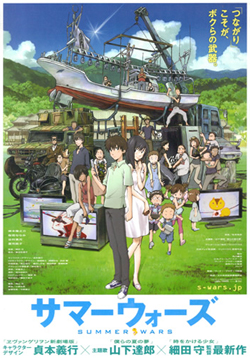
Summer
Wars is a Madhouse production which, in itself, says a lot more than one might
imagine. The first assumption this information allows us to make is that,
whatever the animated feature under discussion is, it will likely succeed in
leaving the viewer spellbound. As might be discerned from our earlier reviews,
we hold this particular studio in a regard bordering on absolute reverence.
The
movie is a visual delight, and some of the sequences are breathtaking, but the
impact made by the images has a charming subtlety to it. Upon inspection, it
may be found that apparent distinguishing features in the faces of characters
are hard to find. but each one is distinctly unique. Their physicalities (as
well as their personalities) are brought out through their stances, mannerisms,
hair, dress-sence, and other quirks, that are maintained throughout the film. This
is something that distinguishes Madhouse and Ghibli’s style of general
storytelling from studios like Disney and Pixar who rely on exaggerated facial
features and very in-your-face physical characterization to aid them in telling
the characters story.
Characters like Naomi and Richi have, on an
average, 2 lines in the entire movie but through their mannerisms and the way
they act around other family members we know not only what kind of people they
are but we can glean something of their relationships with most family members.
Through just a few off-hand remarks and exchanges, the inter-personal equations
within the family are conveyed.
The movements have a soothing fluidity
to them, and as is normal with madhouse, each gesture and movement is very
suggestive of the character’s intentions. While the anatomy is not always
perfect and forms are sometimes more distorted than traditionally acceptable
even in stylistic animation (weirdly spindly and wobbly legs, distribution of
weight in the character’s stance messed up) , they get the point across.
The
house, each character, and even every inanimate object conveys a richness of
its own, suggestive of untold history. Each scenery conveys so much, from taste
in furniture and décor to sentimentality (keeping old photographs and letters
and old artefacts from a bygone golden age) and socio-economic standing
(clearly expensive ceramics, rich wood). It makes one wonder at the monumental
amount of planning and scrutinizing that probably went into sustaining the kind
of entrancing atmosphere created in the movie. The traditional quirks of
japanese animation are also occasionally utilised, more as affectionate accentuation
than anything. Madhouse has always had a knack for developing a very noticeable
style while still keeping well within the boundaries of definition of “anime”
as we know it.
The visual representation of a virtual
realm (along with its users, features, and partial collapse) was more than triumphant,
with red outlines to produce an enticing digital effect, and made the overall
experience even more ingratiating. Not only was the design of the world itself
everything you’d expect from a social network on the verge of world domination
(apparently quirky and fun aesthetic but subtly sleek), but the studio managed
to translate many traditionally boring functions of the program into action
packed sequences using visual metaphors to portray something to an audience of
laymen, events and concepts that would, in actuality, take place quietly and
unnoticed behind a computer screen.
It certainly must have been a task, working
with such a large and diverse cast of characters and trying hard to avoid
letting any of them fade into the background. The animators however,
brilliantly and subtly worked in character personalities purely through
gestures and remarks. One very noteworthy scene at the dinner table brings out
numerous individual characteristics by no means other than simple gestures,
grabs for food, and succinct contributions to a general conversation. The
familial sense of security and acceptance is brought out, where everyone is
aware of each other’s’ eccentricities, and comfortable with them. However, an
established hierarchy, with the grandmother at the head, reminds us of the more
traditional side of this historical family. Some relations transcend domestic
honorifics too, such as that of Kazuma and his grandfather, whom he addresses
as ‘sensei’. We sense the dynamic that is only created through generations of
shared heritage.
The
storyline itself is intense, simultaneously thrilling and humbling. A broad,
yet simplistic perspective laces the twists and turns. By following the global
catastrophe initiated in cyber space, we glimpse the prospective reach and
control of developing technological
institutions. However, the homely setting and allusions to influential ancestry
seem to remind us of the relationships and connectivity that can never be made
obsolete. The fact that one family succeeds in averting a deadly crisis
highlights the idea of opportunities for almost anyone to influence world
events through the internet, but the fact that such carnage could result in the
first place reveals the delicacy of such a system, where the disturbance of one
domino causes all the others to capsize. There is an emphasis on traditional
means of communication that, during the unravelling of online networks, hold
the world in place. It also serves to reinforce one of the primary themes in
the movie, family. This is a family that is spread all over the world but they
still make the time to eat and celebrate with one another whenever they can.
Thousands of years of shared heritage and a stern matriarch determined to keep
them as tight knit as possible has made the family bonds in this movie strong.
So their victory over the forces that seek to destroy OZ is nothing but a
statement on how much a group of people can achieve if they work together as a
family would.
An interesting idea introduced towards
the end is the importance of a family eating together. Two of the worst things
in the world are hunger and loneliness, says Granny, and both can be taken care
of by eating together.
Another interesting touch is the
university baseball league, in which one of the family members is participating
during the gathering, is displayed through a living room television, serving to
mirror the general mood and sentiments in the household. It also provides a
broader perspective by demonstrating that, while one part of the world is in
turmoil, another may function completely unhindered. There are as many
realities as perceptions.
The setting of the movie itself is
delightfully paradoxical. An ancient family apparently stuck in reminiscence of
their golden age is faced with a problem that is purely technological in a way
that is dripping with twenty first century speed and scale. Another interesting
contrast is how, with OZ taken over, communications are down all over Japan
which causes various security and administrative problems. Granny does her part
in rallying up the troops by picking up an old fashioned phone and calling up
old friends and family. In the face of a communications disaster, where the
internet, the ultimate form of communication is down, here is an old woman who
does the simplest thing she can think of, she picks up a phone and calls to see
what she can do.
The
problem of unaddressed plotlines is unlikely to turn up, as this movie has
great, but tasteful, finality. No character or dispute once introduced is ever
forgotten, and everyone gets necessary screen time. They are portrayed as
individuals with distinguishing strengths, that all contribute in their own way
to the ultimate solution of a conflict. As a whole, the movie exudes a pride
and reverence for tradition, family ties and friendship, all the while
appreciating the majesty and intricacy of globalized technology.

No comments:
Post a Comment